
A Simpler Contractor Answering Service Alternative
Is there a simpler alternative to hiring a contractor answering service?
If your real problem is missed calls while the team is working, driving, or off the clock, Book Every Job can be a simpler alternative to a traditional contractor answering service.
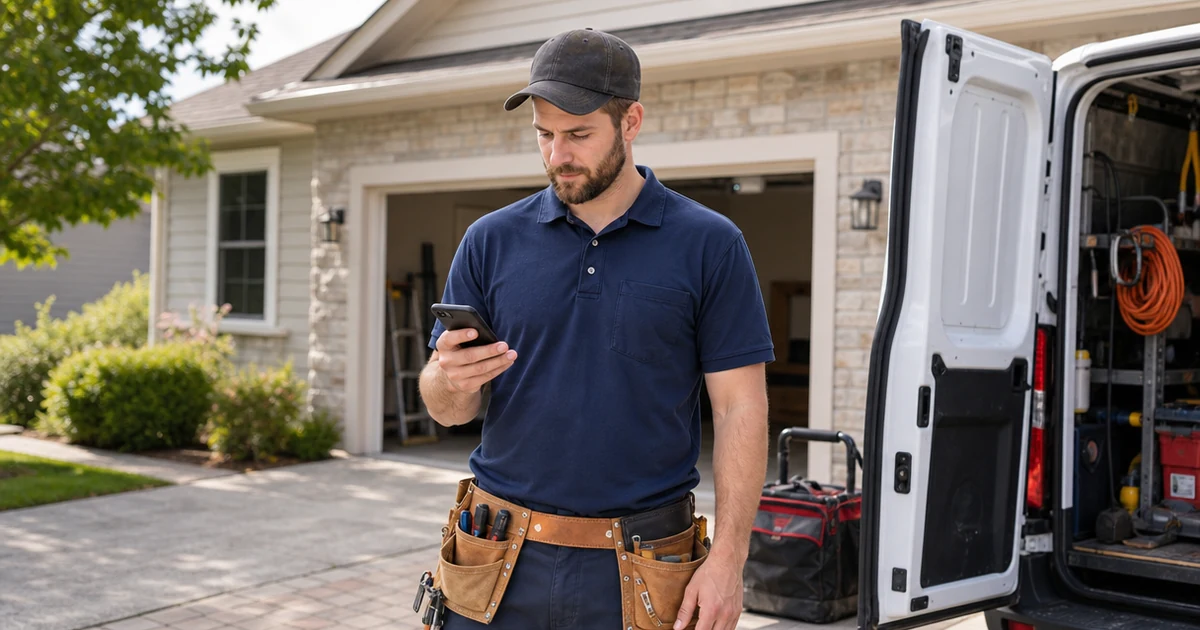
A small residential service business is missing calls while the team is on jobs, driving, after hours, already on another call, or working with customers.
Direct answer
Book Every Job is for residential service contractor teams that miss homeowner service calls and need fast text-back, job-detail collection, filtering, and booking support without adding unnecessary call complexity.
Use a contractor answering service when most calls need a live person. Use Book Every Job when the main problem is missed-call recovery, intake, filtering, and booking or routing after the call is missed.
Why contractors start shopping for answering services
Small field teams miss calls because the work is mobile, interruption-heavy, and often happens away from a desk. The owner may be driving between jobs, the technician may be under a sink or in an attic, and the office may already be on another call. The search for a contractor answering service usually starts when callbacks are too slow, voicemails are incomplete, and real homeowner opportunities are hard to separate from spam. The decision is not always live operator coverage versus nothing. Often the better question is whether the business needs every call answered live or needs a reliable missed-call response layer that captures the job details quickly.
This page compares traditional contractor answering services with missed-call text-back and booking support so you can decide which fit makes sense.
Where Book Every Job fits and where it does not
This page is for residential service businesses where homeowner calls affect whether a job is won or lost.
Good fit
Best fit: small residential service teams that miss calls during jobs, driving, after hours, or while already helping customers.
- Small residential service teams that receive homeowner service calls
- Owner-operators or lightly staffed offices that miss calls during active work
- Businesses where response speed affects whether the job is won
- Teams that want missed-call text-back and booking without adding a call center
Not the right fit
Not a fit: businesses that need complex dispatch, live emergency triage, or full-time live coverage on every call.
- Commercial-only operators with long bid cycles
- Builders, remodelers, subcontractors, or new-construction-only companies
- Businesses that need live human coverage on every call
- Companies that already have complete call-center coverage and no missed-call problem
When to use an answering service, Book Every Job, or both
Use an answering service when…
Use a live answering service when every call needs a human receptionist, complex dispatch judgment, emergency triage, or full-time live coverage.
Use Book Every Job when…
Use Book Every Job when the main issue is missed-call recovery, fast text follow-up, job-detail collection, spam filtering, and booking support for qualified calls.
Use both when…
Yes. Some businesses can use a live answering service for front-line coverage and Book Every Job for missed calls, after-hours text-back, or calls that slip through.
How Book Every Job works after a missed call
A traditional answering service is designed to answer calls live. Book Every Job starts when a homeowner call is missed. It sends a text response, collects the issue and service address, filters low-fit calls, and can help move qualified requests toward booking or review.
1. A call is missed
A lead calls while the team is on a job, driving, or off the clock.
2. Fast text goes out
Instead of routing every call to a live agent, BEJ responds only when the call is missed.
3. Customer replies with context
The caller shares the issue, timing, or address by text.
4. Team steps in with context
Your team takes over once the conversation is already active.
Book Every Job vs. a contractor answering service
A traditional answering service is strongest when the business needs a live person to answer most calls. Book Every Job is strongest when the real gap is missed-call recovery: immediate text response, job-detail collection, spam filtering, service-area checks, and booking support when rules are configured. Some teams may use both, with live answering as the front line and Book Every Job as the safety net for calls that still slip through.
| Need | Traditional answering service | Book Every Job |
|---|---|---|
| Live human answering | Strong fit when every call needs a live person. | Not the main purpose. Book Every Job responds after missed calls by text. |
| Missed-call recovery | Depends on routing, coverage window, and handoff quality. | Core workflow: missed call triggers an immediate text response. |
| Text follow-up | May be available, but usually as part of a broader live-answering workflow. | Text follow-up is the main response layer. |
| Job detail collection | Captured by a live agent using a script. | Collected through a text conversation with the homeowner. |
| Spam and wrong numbers | Can still consume operator time. | Can classify spam, wrong numbers, vendors, and low-fit requests before distracting the owner. |
| Calendar booking | Depends on the service, script, access, and booking rules. | Can book qualified jobs when calendar rules are configured. |
| After-hours calls | Useful when live after-hours operators are required. | Useful when the goal is immediate text response and intake after a missed call. |
| Setup complexity | May require scripts, call routing, account configuration, and operator instructions. | Requires phone routing, messaging compliance, business rules, and calendar setup, but not live-agent coverage. |
| Cost model | Often priced around live coverage, minutes, call volume, or after-hours support. | Focused on missed-call recovery and booking workflow. Pricing should be confirmed from the current offer. |
| Best fit | Businesses that need live human coverage for most or all calls. | Small residential service teams that need a safety net for calls they cannot answer. |
| Using both together | Can remain the live-answering layer. | Can act as missed-call, after-hours, or text-back layer for calls that slip through. |
| Service area and qualification | Depends on the live agent script and handoff process. | Can collect service address and use configured rules before booking or routing. |
| Human judgment and dispatch complexity | Better fit when a caller needs live judgment, emergency triage, complex dispatch, or a human receptionist experience. | Collects details and routes the request when the call needs review instead of automatic booking. |
| Calls outside normal rules | A live agent may decide what to do based on the script and escalation rules. | Collects the request, service address, and context, then routes outside-area, unusual, or uncertain requests for human review. |
The practical difference
- A traditional answering service is best when most calls need a live person.
- Book Every Job is best when the main gap is missed-call recovery and fast text follow-up.
- Some businesses can use both, with Book Every Job covering calls that still slip through.
Cost and setup: when an answering service is more than you need
A contractor answering service is usually priced around live coverage, call volume, minutes, scripts, and after-hours staffing. Book Every Job focuses on a narrower gap: the call was missed and the caller needs a fast text path before the opportunity goes cold.
What setup usually involves
Most businesses keep their existing phone number. Setup depends on the current phone provider, missed-call forwarding options, messaging compliance, service-area rules, calendar access, and booking rules.
Why missed-call speed matters
Homeowners do not reliably wait or leave voicemail after a missed contractor call.
Common missed-call situations this covers
These are the kinds of calls and workday moments where a missed-call text-back layer can help without pretending every request should be booked automatically.
Missed-call moments
- Owner is under a sink or on a ladder and cannot safely answer
- Technician is in a basement, attic, crawlspace, or mechanical room
- Owner is driving between jobs
- Office/admin is already on another call
- Calls come in after normal hours
- Calls hit voicemail during lunch or after a job runs long
- Seasonal demand creates call spikes
- Homeowner hangs up instead of leaving a voicemail
- Callback happens after the homeowner has already contacted another company.
High-intent job types
- No cooling or no heat
- Active plumbing leak or water heater issue
- Electrical panel, outlet, or power concern
- Garage door stuck open or closed
- Appliance repair request
- Handyman repair request
- Urgent estimate request
- Repeat customer needing service
- Homeowner asking for next available appointment
- After-hours issue that can be captured for review.
Calls to filter or review
- Spam or robocalls
- Sales/vendor calls
- Wrong numbers
- Commercial-only inquiries
- Builder or subcontractor work
- New-construction-only requests
- Requests outside the service area
- Requests outside configured appointment types
- Emergencies that require human judgment
- Existing-customer billing or warranty issues that should be routed instead of auto-booked.
How service area and booking rules are handled
Book Every Job should only move a call toward booking when the request matches the business rules. When something is uncertain, the safer workflow is to collect the details and route the lead for review.
Service area checks
Collect the service address before booking. Use configured service-area rules before offering appointment times. If the address is outside the normal area or unclear, collect the details and route the lead for review instead of auto-booking.
Booking qualification
Book directly only when calendar access, service area, appointment types, minimum lead time, business hours, emergency rules, and qualification rules are configured. If the request falls outside those rules, collect the job details and notify the business for follow-up.
Contractor answering service alternative FAQs
Is Book Every Job a contractor answering service?
No. Book Every Job is not a live answering service or call center. It responds by text after a call is missed, collects the job details, filters low-fit calls, and can help move qualified service calls toward booking.
When is an answering service still the better choice?
A traditional answering service is the better choice when every call needs a live person, complex dispatch judgment, emergency triage, or a human receptionist experience. Book Every Job is better when the main problem is missed-call recovery and fast text follow-up.
Can Book Every Job work together with an answering service?
Yes. Some businesses may use an answering service for live coverage and Book Every Job as a missed-call or after-hours text-back layer for calls that still slip through.
What types of contractors is this for?
It is for residential service businesses that receive homeowner calls, including HVAC, plumbing, electrical, garage door, appliance repair, handyman, and similar service teams. It is not mainly for builders, commercial-only operators, or subcontractors that do not depend on homeowner service calls.
Does this use an AI voice bot?
No. Book Every Job is text-first. It does not need to put an AI voice bot between the customer and the business. The workflow starts after a missed call and continues by text.
Can it book jobs directly?
Yes, when calendar rules, service area, appointment types, and booking rules are configured. If the request needs review, Book Every Job can collect the details and notify the business instead of auto-booking.
Do I have to change my main phone number?
The usual setup is designed so the business keeps its existing number and routes missed calls into the Book Every Job workflow. The exact setup depends on the current phone provider and call forwarding options.
What happens to spam or sales calls?
The system can help classify spam, wrong numbers, vendors, and low-fit calls so the owner is not chasing every missed call manually.